

Why Listed Real Estate Deserves a Bigger Role in European Insurers’ Portfolios
By David Moreno, CFA, CAIA,
Director of Indexes & Research
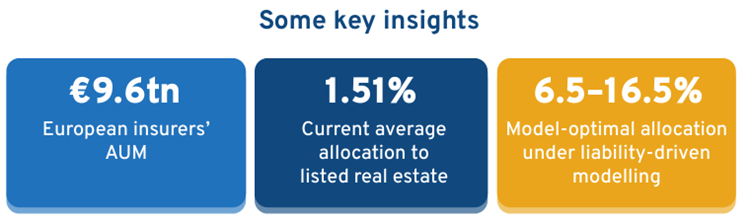
European insurers are among the continent’s largest institutional investors, managing more than EUR 9 trillion in assets. Their investment decisions are driven not only by expected returns and risks, but also by the need to match long-term liabilities, maintain liquidity and operate within the regulatory limits, in particular the capital requirements of Solvency II. As insurers reassess their strategic asset allocations in a world shaped by political uncertainty, market volatility and evolving economic drivers, the way how they access real assets is particularly important, and the role of listed real estate is more relevant than ever.
EPRA recently released a new academic research, Listed Real Estate in European Insurers’ Portfolios, authored by Pin-Te Lin and Yuan Zhao from the University of Reading. The study examines this question from an insurer-specific perspective, comparing different asset classes, including listed, unlisted and direct real estate. It also goes beyond traditional portfolio optimisation by incorporating insurers’ liabilities and regulatory capital requirements. The findings suggest that listed real estate remains significantly underutilised in European insurance portfolios despite offering compelling diversification, liability-hedging and liquidity benefits, where the implementation of the Long-Term-Equity Module under Solvency II can provide a valuable framework to take advantage of all the benefits that REITs and property companies can provide.
Access the report here and the Executive Summary here.
European insurers are changing how they access real estate
The composition of European insurers’ portfolios has evolved considerably in recent years. EIOPA data covering Q4 2017 to Q4 2024 show that the overall allocation to equities increased from around 11.6% to 16.5%, while collective investment undertakings increased from approximately 30% to 36%. In parallel, the total exposure to real estate shows some stability together with a clear shift away from direct property ownership and towards indirect real estate exposure.
Listed real estate increased slightly from approximately 26.6% to 28.0% of the total real estate exposure, while unlisted real estate rose from around 37.2% to 45.5%. In contrast, direct real estate declined from 35.4% to 26.5%. Therefore, the direction of travelpoints increasingly towards indirect routes to property investment.
This transition reflects the practical advantages of listed and unlisted vehicles. Compared with direct property, listed real estate offers greater liquidity, lower transaction costs, easier implementation and access to professional management teams capable of repositioning assets and creating long-term value. The research also highlights that insurers increasingly favour larger listed property companies, reinforcing the importance of liquidity in strategic asset allocation decisions.
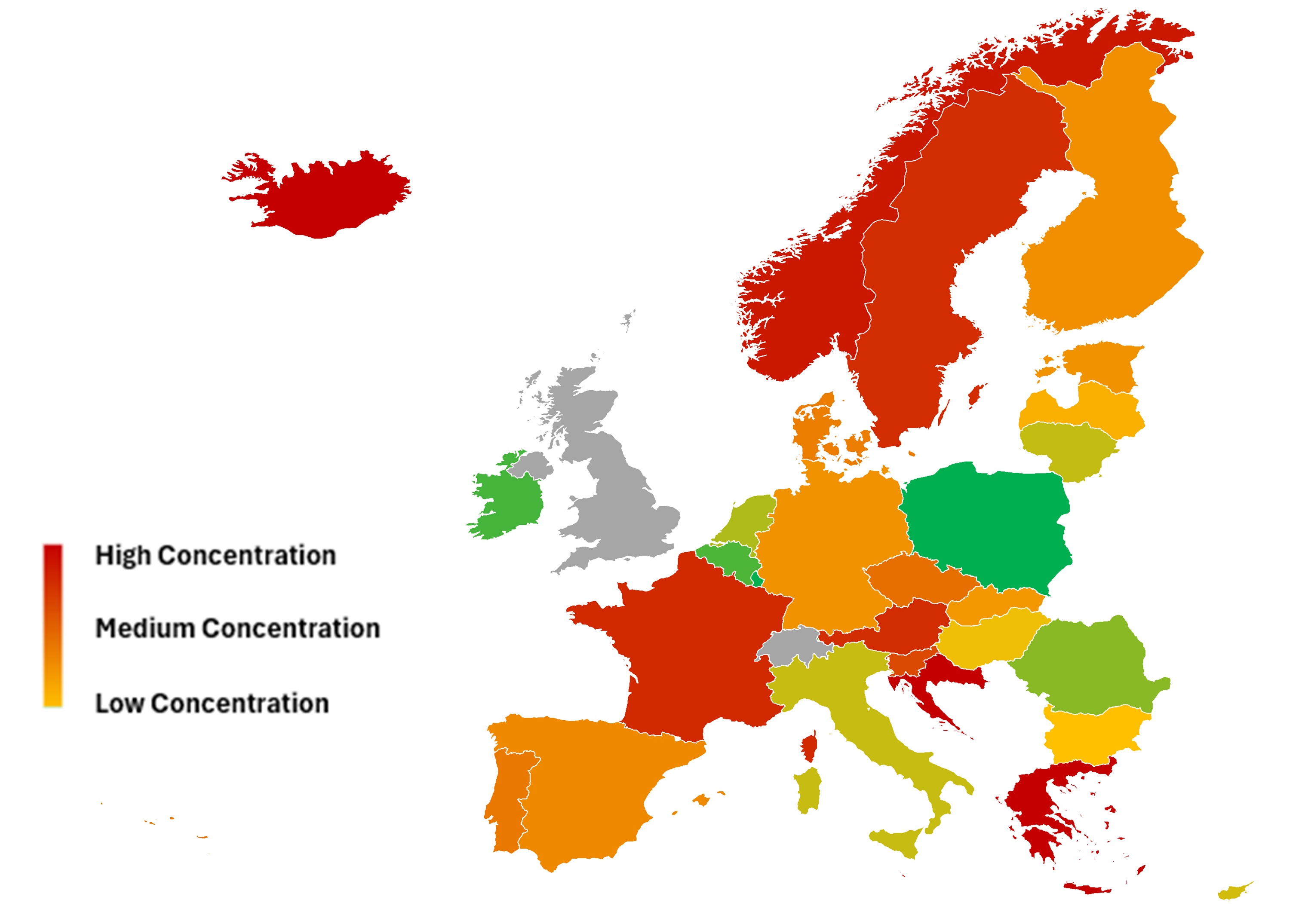
However, by analysing the EIOPA data in detail, EPRA also found another important characteristic: a strong home bias in the listed real estate allocation. Insurers tend to concentrate their listed real estate investments in their domestic markets rather than taking full advantage of the geographical diversification available through public real estate markets.
European Insurers’ Real Estate Equity Allocation – Concentration by country
Source: EPRA’s own calculations on EIOPA’s Q4-2025 dataset.
This distinction matters. One of the fundamental advantages of listed real estate is precisely the ability to obtain exposure to diversified property portfolios across countries, cities and property sectors without many of the operational and transaction-cost barriers associated with direct cross-border property investment. Reducing home bias could therefore allow insurers to use the listed market not simply as another route into real estate, but as an efficient mechanism for broadening their real estate exposure across Europe and even other global markets.
The role of listed real estate changes when liabilities are considered
Most asset allocation studies evaluate investments through a traditional mean-variance framework, focusing on maximising returns relative to risk. Within that framework, listed real estate appears to play only a modest role, while unlisted real estate often dominates portfolio allocations. However, insurers are not traditional investors. Their primary objective is not simply to maximise returns, but to generate assets that can reliably meet long-term liabilities. This is where the report makes its most significant contribution.
By incorporating Asset-Liability Modelling (ALM), the research demonstrates that listed real estate becomes considerably more valuable when liabilities are included in the optimisation process. Rather than viewing assets in isolation, ALM evaluates how effectively investments support future obligations and surplus stability.
The study tests three different liability proxies: technical provisions, total liabilities and a duration-matched portfolio. Across all 12 liability-hedging scenarios examined, listed real estate achieves the highest liability-hedging score among the asset classes considered.
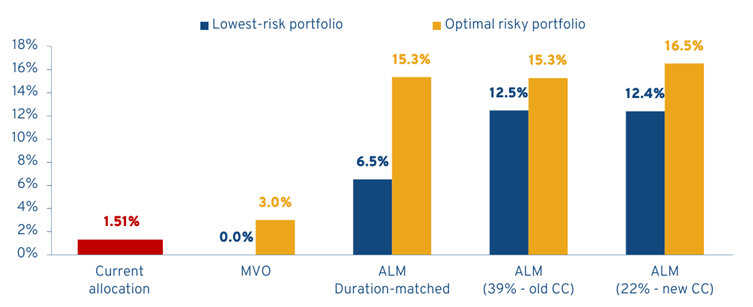
Consequently, optimal allocations to listed real estate under the different ALM specifications range from 6.51% to 16.29%, depending on the model, liability proxy and risk appetite. This compares with a current average allocation of just 1.51%.
The results suggest that an asset-only approach may understate the potential strategic contribution of listed real estate for insurers. Its combination of real estate exposure, liquidity and liability-hedging characteristics becomes particularly relevant when portfolios are considered through an ALM lens.
The Long-Term Equity Opportunity
This brings the discussion to the Long-Term Equity (LTE) module under Solvency II. Historically, listed real estate was treated as standard equity, carrying a 39% capital charge. Under the LTE framework, qualifying investments, including eligible listed real estate, can benefit from a reduced 22% capital charge.
The report demonstrates that this lower capital requirement further strengthens the case for listed real estate. Under the LTE regime, recommended allocations rise to between 12.4% and 16.5%, while risk-adjusted surplus outcomes also improve. Although liability-hedging characteristics remain the primary driver of portfolio allocations, the more favourable regulatory treatment enhances the attractiveness of listed real estate within insurers’ strategic allocations.
Listed real estate allocation
Current vs optimal range under different techniques and capital charges
Source: Listed Real Estate in European Insurers’ Portfolios . University of Reading. EIOPA’s dataset.
These findings provide practical evidence that the LTE framework can help better align regulatory capital treatment with the long-term economic characteristics of listed real estate. For insurers seeking efficient ways to combine long-term and property-driven returns, geographical diversification, liability matching and capital optimisation, this represents a significant opportunity.
For insurers, asset managers, consultants and policymakers, the implications of this research are clear: listed real estate deserves greater consideration within liability-driven investment portfolios.
Join the conversation
This week EPRA is hosting a webinar to explore these findings in greater detail, where Insurance Europe, the European Commission and Milliman will discuss the practical implementation of the Solvency II Long-Term Equity framework and its implications for listed real estate allocations. The session will combine regulatory, industry and technical perspectives as well as practical considerations involved in implementing LTE across investment, governance and risk-management processes. Building on both academic evidence and industry experience, the session will provide valuable insights into how insurers can better integrate listed real estate into long-term portfolio construction.